Article: California Cannabis Packaging Requirements 2026
California Cannabis Packaging Requirements 2026
DCC packaging and labeling laws have been updated in 2026 to fall in line with CR regulations for mylar bags that are compliant with California's current standards.
Read full article by going to: 20 min read
California contains one of the most heavily regulated cannabis markets globally. Very specific packaging and labeling requirements for each licensed cultivator, manufacturer, distributor, and retailer are prescribed by the Department of Cannabis Control in California. These are accompanied by real penalties for infractions in the form of fines, suspensions, or even the revocation of one's license.
Is your dispensary in need of purchasing mylar bags, a brand working on labels, or a manufacturer whose goods are destined for the point of sale through retail stores? This guideline highlights for 2026, with the most recent regulatory changes effective from January 1, 2026.
Official Source
California’s provisions on marijuana packaging shall be governed by Title 4, Sections 15000 to 17905 of the California Code of Regulations, with the last amendment that took effect on January 1, 2026, under the Medicinal and Adult Use Cannabis Regulations (MAUCRSA). Always check the current rules in place at cannabis.ca.gov.
Packaging Requirements of 4 Core Regulatory Provisions
Every retail-shelf cannabis product in California is governed by four core rules on packaging:
1. Child-Resistant
State law requires that all cannabis goods are sold in child-resistant packaging (CRP). CRP is packaging that is designed to be hard for children under five years of age to open. It is the responsibility of the licensee that packaged the cannabis good to make sure that the package meets CRP requirements.
California recognizes two tiers of CRP. Which tier you need depends on how your product is used:
Single-Use CRP
- Will only be child-resistant upon initial opening
- Shall bear the label saying: "This package is not child-resistant after opening"
- Applies to Flowers, flower-only pre-rolls, topicals, and inhaled concentrates
- Example: a heat-sealed mylar bag with regular zipper
Lifetime / Multi-Use CRP
- Maintains child-resistance through every subsequent opening
- It is a requirement for any product with multiple servings
- Applies to: Edibles, orally consumed concentrates, tinctures, suppositories
- Example: CR mylar bags with locking pinch-and-pull zipper mechanism
2. Tamper-Evident
All cannabis items must be in packaging that will clearly show if the product has been opened or tampered with before purchase. Proper tamper-evident features would include heat seals across openings, shrink bands around lids, break-away and induction seals, and any closure that leaves the obvious entry evidence. In mylar bags, it is the initial heat seal at the top that serves as the tamper-evident feature.
3. Resealable (for multi-use products)
Products that have more than one serving shall be resealable. Products that would require resealing in California are differentiated as follows: multi-serving edibles, orally consumed concentrates served by size, tinctures, and any manufactured cannabis goods sold with more than one use per container. Single-serving products, like an individual pre-roll, do not need resealable packaging.
4. Opaque
Edible products can't be visible from the outside. Opaque means no peeking. Although amber bottles qualify, and beverage containers can have a narrow clear strip less than 0.25" wide to mark servings.
For flower and non-edible products, opaque packaging is also standard practice and expected by the DCC - clear or windowed mylar bags are not appropriate as primary California cannabis packaging.
California Labeling Requirements for Cannabis, 2026
The state of California dictates that every product falling under the category of cannabis be required to have a two-panel label: The primary panel is the top front part of the package visible to the consumer, whereas the other one, being an informational panel, is everywhere else around it. Each panel, as such, has its own set of required elements.
Primary Panel (front/top)
- California Universal Symbol — black, min 0.5" × 0.5"
- Product Identity — generic name (e.g. "Cannabis Flower", "Vape Cartridge")
- Net Weight or Volume — in both metric AND US customary units
- "Cannabis-Infused" — edibles only; in bold, larger font, above product identity
Informational Panel (back/sides)
-
Licensee Name + Phone or Website — legal name or DBA as on license
-
UID Number — METRC track-and-trace unique ID
-
Date of Manufacture/Packaging — month/day/year
-
Batch or Lot Number — must be on informational panel, not supplemental
-
Government Warning Statement — bold, all caps
-
Prop 65 Warning — required since January 3, 2020
-
Cannabinoid Content — THC & CBD per package (mg); per serving for edibles/concentrates
-
Allergens — "Contains [allergen]" — if applicable
-
Ingredients List — descending by weight/volume — manufactured products only
-
Nutrition Info — fat, carbs, sodium, sugar per serving — edibles only
-
Expiration/Use-by Date — if applicable
Universal Cannabis Symbol — Exact Specs
Universal Symbol — California symbol for identifying items as containing cannabis. It shall be black with a minimum size of 0.5" x 0.5". This symbol must not change color, be edited, or distorted in any way, etc.—only uniform scaling shall be employed. The official symbol can be downloaded from cannabis.ca.gov. All products— flowers, edibles, concentrates, vapes, and topicals—require this symbol on their primary panel packaging.
Government Warning Statement — Required Exact Text
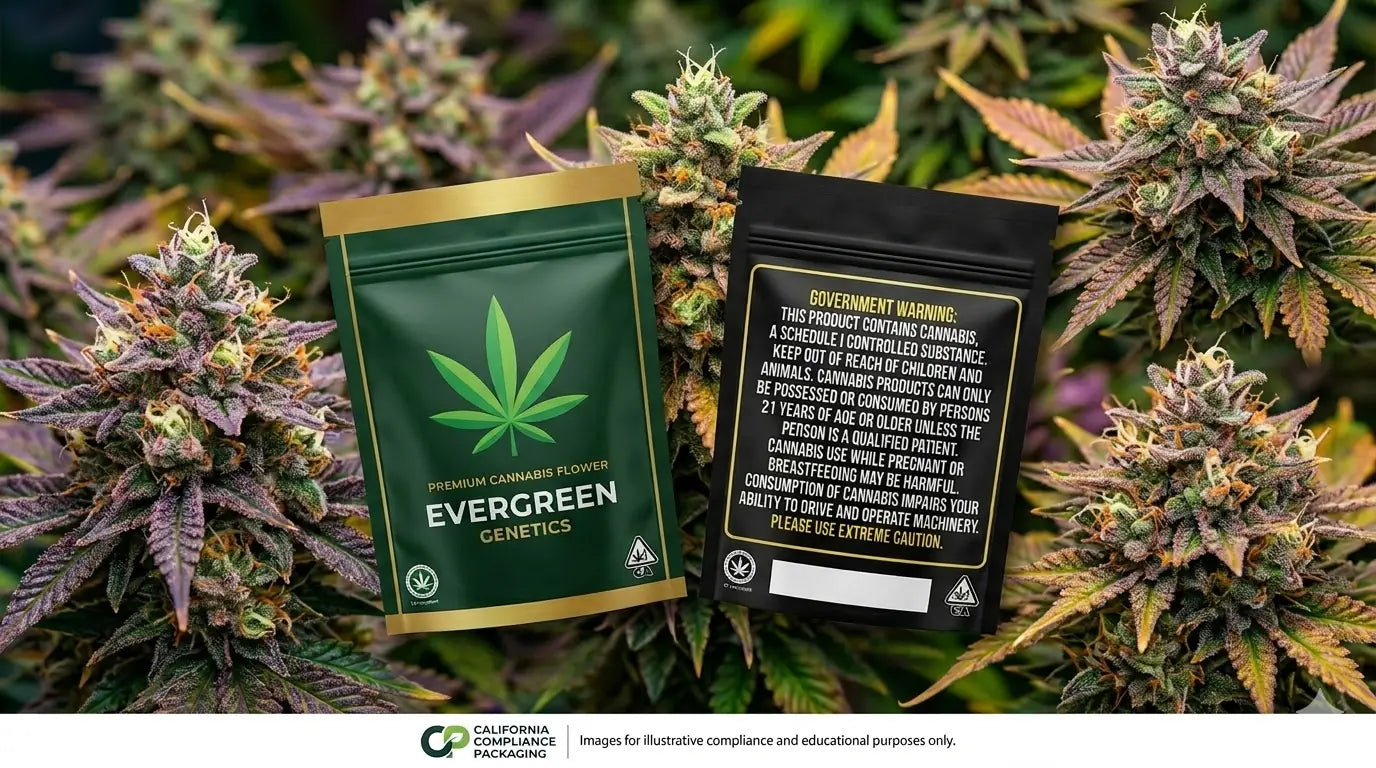
All California cannabis products must display this warning in bold, CAPITAL LETTERS:
GOVERNMENT WARNING: THIS PRODUCT CONTAINS CANNABIS, A SCHEDULE I CONTROLLED SUBSTANCE. KEEP OUT OF REACH OF CHILDREN AND ANIMALS. CANNABIS PRODUCTS CAN ONLY BE POSSESSED OR CONSUMED BY PERSONS 21 YEARS OF AGE OR OLDER UNLESS THE PERSON IS A QUALIFIED PATIENT. CANNABIS USE WHILE PREGNANT OR BREASTFEEDING MAY BE HARMFUL. CONSUMPTION OF CANNABIS IMPAIRS YOUR ABILITY TO DRIVE AND OPERATE MACHINERY. PLEASE USE EXTREME CAUTION.
It is also required that a separate Proposition 65 warning be added, as the OEHHA in California has posted that marijuana smoke and THC are both turned out to be reproductive toxins and carcinogens.
Content Labeling of Cannabinoids
The label must also indicate the content of these cannabinoids in percentage terms (e.g. THC 18%; CBD 1.5%). If any of the other cannabinoids are above 5%, their concentrations must be shown in relation to their THC and CBD content in milligrams per package for all products produced. In this part of the label for edibles and concentrates with designated serving sizes, the percentages of THC and CBD by weight shall be specified on a per-serving basis in milligrams.
Small Package Supplemental Labels
When the size of the package does not allow the business to get all the required information on a single label, California allows additional small, supplemental labels in the form of a hang-tag, peel-back/ peel-and-reveal labels, or a physical insert only. It may not make use of websites, QR codes, or any other means to remove information from the package itself. The required information must be physically displayed on or with the packaging for sale.
Minimum Font Requirements
The minimum size of the font for the content of the information panel shall be 6 pt as compared to the primary panel and container. The labels shall be in English and shall be readable and located only on the outer surface of the packaging. Labels shall not be affixed inside the container, which would be unsatisfactory according to the required provisions.
What California Cannabis Packaging Cannot Include
The DCC's prohibitions are as important as its requirements. Violations in these areas carry the most serious license consequences.
Prohibited Design Elements
- Cartoons, animated characters, or cartoon-adjacent imagery
- Imagery that could appeal to minors (candy, toy-like, mascots)
- Designs that imitate mainstream food, snack, or beverage brands
- Images or photographs of the cannabis product itself (edibles)
- Packaging shaped like animals, fruit, candy, or toys
- The words "candy," "candies," or similar
Prohibited Claims & Words
- Unproven health or therapeutic benefit claims
- "Organic" or "OCal" — unless CDFA or CDPH registered
- County name — unless 100% of cannabis grown there
- References to alcoholic beverages (without separate alcohol license)
- Any claim suggesting safe use during pregnancy
- "Disposable," "trash-ready," or "recyclable" — for vape products
Product-Specific Packaging Rules
Cannabis Flower & Pre-Rolls
- Child-resistant packaging — single-use CRP acceptable for single-serving
- Single-use packages must carry label: "This package is not child-resistant after opening"
- Primary panel: universal symbol, product identity (e.g. "Cannabis Flower"), net weight in metric + US units
- Informational panel: licensee name/contact, UID, date of packaging, government warning, THC/CBD % by weight, THC/CBD mg per package
- Any cannabinoid above 5% of total content must be individually listed
Edible Cannabis Products
- Hard THC cap: 100mg total per package · 10mg maximum per serving
- Single-use CRP for items like flower and topicals, and lifetime CRP for edibles and other orally consumed products.
- Must be fully opaque — no clear windows permitted
- "Cannabis-Infused" must appear immediately above product identity in bold, larger font
- Photographs or realistic images of the actual product are prohibited
- Multi-serving edibles must have each serving individually wrapped or clearly scored/marked
- Must list ingredients in descending order by weight/volume
- Allergen disclosure required: "Contains [allergen name]"
- Nutrition facts required: total fat, carbohydrates, sodium, sugar per serving (in grams/milligrams)
- Packaging cannot resemble conventional food or snack packaging
Cannabis Concentrates
- Single-serving concentrates: single-use CRP acceptable
- Multi-serving concentrates (e.g. dabs with designated serving size): lifetime CRP required
- THC and CBD must be listed per serving AND per package in milligrams
- DCC regulations are particularly strict on residual solvent claims and potency accuracy
- Any cannabinoid above 5% of total content must be individually listed on the label
Cannabis Vape Cartridges & Integrated Vaporizers
Vapes carry additional requirements under Business and Professions Code §26120(f) and §26152.1 (AB 1894):
- The packaging and labeling of cannabis cartridges and integrated cannabis vaporizers cannot include statements that indicate or imply that the items are disposable, may be thrown in the trash, or added to recycling streams.
- All packaging must include proper hazardous waste disposal instructions
- All advertising and marketing must display DCC-mandated disposal messaging
- Standard CRP, tamper-evident, and labeling requirements all apply
Cannabis Topicals & Tinctures
- Child-resistant packaging required
- Standard two-panel label with universal symbol, net weight/volume, government warning
- Tinctures: typically glass or plastic vials with CR dropper caps or CR closures
- No therapeutic or medical claims permitted
- Multi-serving tinctures: lifetime CRP and resealable packaging required
Animal Cannabis Products
The Office of Administrative Law has approved and filed the Department of Cannabis Control's regulatory action to adopt regulations implementing Assembly Bill 1885, which requires the DCC to establish standards for animal cannabis products. These regulations take effect on January 1, 2026. Cannabis products shall not be marketed or sold for use on, or consumption by, animals before these regulations for animal standards take effect. Watch cannabis.ca.gov for animal-specific packaging guidance as this new category develops.
What Changed in California Cannabis Packaging in 2026
DCC Medicinal & Adult Use Cannabis Regulations Updated — Jan 1, 2026DCC regulations can be found in the California Code of Regulations, Title 4, sections 15000 through 17905. These are available online via Westlaw, or through a searchable copy of the Medicinal & Adult Use Cannabis Regulations (updated January 1, 2026) document. This is the authoritative reference for all 2026 packaging and labeling requirements. Every licensee should have confirmed compliance against the January 2026 version.
AB 8 — Hemp Extract Purity Standards (Jan 1, 2026)AB 8 introduces strict standards effective January 1, 2026. Industrial hemp extracts used in food, beverages, or supplements must be CBD or CBN isolate with over 99% purity and cannot contain any THC or synthetic cannabinoids. This significantly narrows what hemp-derived products can legally be sold in California and affects labeling requirements for any product using hemp extracts.
AB 1885 — Animal Cannabis Products Now DCC Regulated (Jan 1, 2026)The DCC officially began regulating cannabis products for animals on January 1, 2026. Starting January 1, 2026, the DCC officially regulates cannabis products for animals. Assembly Bill 1885 establishes comprehensive standards for pet cannabis products, allowing veterinarians to discuss cannabis treatments for conditions like arthritis and anxiety in pets. Full product-specific packaging standards for this new category are still emerging — monitor DCC rulemaking for updates.
All Provisional Licenses Expired — Jan 1, 2026California provisional cannabis licenses expired permanently on January 1, 2026. Only annual DCC licenses are now valid. Packaging consequence: any products labeled with a provisional license number are now non-compliant. All labels must reference current annual license numbers. Operating on an expired provisional license after January 1, 2026 is illegal.
Child-Attractive Packaging Enforcement Rubric — 2026 RolloutFollowing findings from a 2025 California State Auditor report identifying inconsistent enforcement of child-attractive packaging rules, the DCC is developing a formal enforcement rubric that describes specific prohibited design elements. This rubric is expected to be completed and published in 2026, leading to more consistent — and stricter — enforcement of design restrictions across the industry.
SB 1511 — Medicinal Cannabis in Hospitals (2026)Terminally ill patients in California hospitals may now use medicinal cannabis for palliative care under SB 1511. Medicinal cannabis products used in hospital settings still require full DCC packaging compliance — this legislation does not create exemptions for packaging or labeling requirements.
Mylar Bags & California Cannabis Compliance
Mylar bags are the most popular primary packaging format for California cannabis flower — and for good reason. They're cost-effective, smell-proof, lightweight, and available in every major dispensary size. But not all mylar bags meet California's requirements. Here's exactly what to look for.
Compliant Mylar Bag Checklist
- Fully opaque — no clear or windowed panels
- CR certified — supplier provides PPPA/ASTM D3475 documentation
- Tamper-evident — heat seal at opening (visible if broken)
- Resealable zipper — CR-locking type for multi-use products
- Multi-layer construction — odor barrier, food-safe materials
- Adequate label area — space for all required primary + info panel elements
Red Flags — Non-Compliant
- Clear or transparent front window panels
- No CR certification documentation from supplier
- Child-attractive graphics (cartoons, candy-like designs)
- Standard zip-lock with no CR mechanism (multi-use products)
- Designs mimicking snack, candy, or food brands
- No tamper-evident heat seal
Which Mylar Bag Type Do You Need?
For single-serving flower (3.5g, 7g, 14g): a standard heat-sealed opaque mylar bag with CR certification works — as long as you label it "not child-resistant after opening." For edibles and multi-serving products: you need a mylar bag with a CR-locking zipper mechanism that maintains child-resistance through every open/close cycle.
California-Ready Bags at A2Z Smoke Shop
We carry a wide range of opaque mylar bags in every major cannabis size — all sold empty as packaging materials. Available in a huge variety of brand-style designs for dispensary branding.
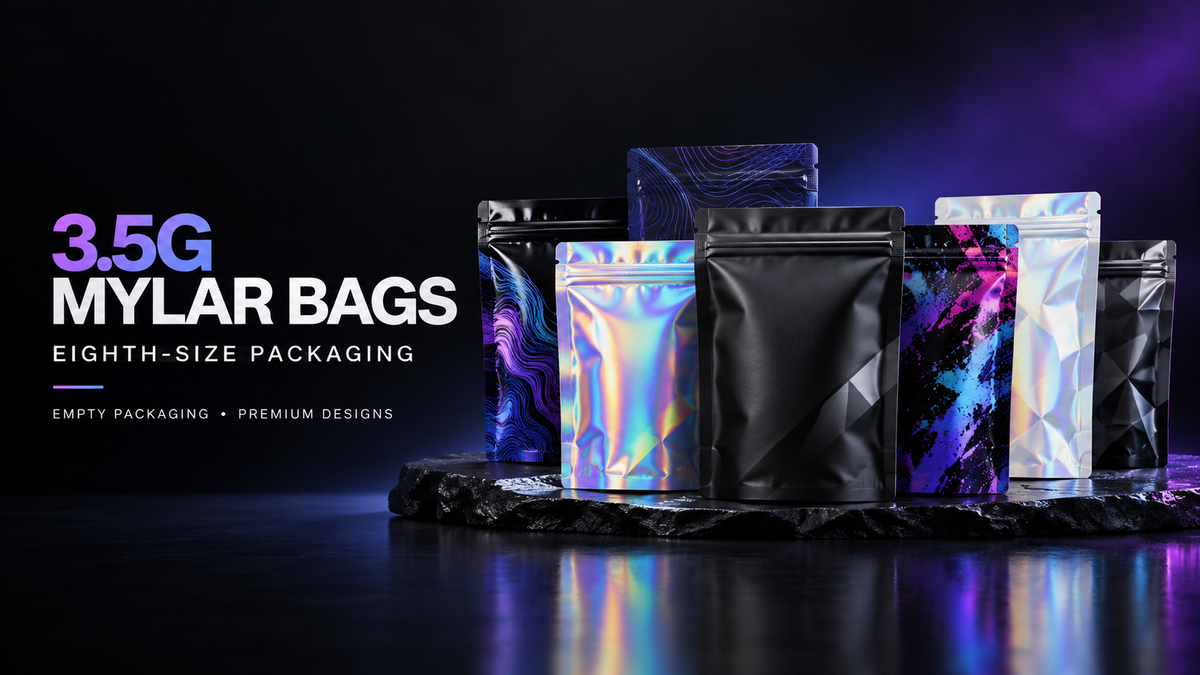
3.5G Mylar Bags: Most popular California dispensary size. Huge brand style variety.
1 OZ Mylar Bags: For larger portions. Full ounce California-ready options.
Bulk / Pound Bags: For cultivators and bulk processors handling larger volumes.